5 Things You Might Not Know About FFTC Leader Laura Yates Clark
As a long-time nonprofit executive and former head of United Way of Greater Charlotte, Laura Yates Clark knows the Foundation. And as a Charlotte native who has spent her entire career in the area, Laura Yates Clark knows the region.
But how well do you know Laura Yates Clark?
For instance, did you know the president and leader of FFTC was also a tap dancer, amateur Italian cook and former Orange Julius devotee? If not, here are five more facts about Laura you might not know:
1. She was not an Eastland Mall ice skater
For most Charlotte natives born before, say, 2000, the first question you normally get is, “Did you used to ice skate at Eastland Mall?” For Laura, the answer is no, but she did spend a lot of time in the mall at Claire’s and Orange Julius.
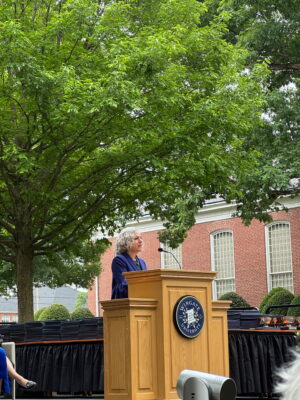
Education has always been important to Laura Yates Clark, pictured giving a commencement address at Wingate University.
The youngest of three children born to Jane and Leo Yates (who Laura named her heroes in a 2015 Charlotte Business Journal profile), Laura grew up in an era of great change for the region. Her first job was as a teenager at the former Black Forest Books & Toys located at the Arboretum shopping center. In typical Laura fashion, and with a lifelong desire to serve, her second job was at a domestic violence shelter when she was attending Appalachian State University in Boone. She graduated App in 1999 with a bachelor’s in psychology.
“Sometimes I wonder about what it would have been like to go to other communities and try it out, but I love Charlotte and it’s offered me so much,” Laura said about her career journey. “Plus, my family’s here. So, it just seemed to make sense to stay.”
After earning her undergraduate degree, Laura returned home to attend UNC Charlotte, where she received her master’s in clinical/community psychology in 2002. She’d later give back to her alma mater by joining the UNC Charlotte Board of Visitors and serving on the board of the UNC Charlotte Institute for Social Capital (now called Charlotte Regional Data Trust). In 2026, the university honored Laura with its Distinguished Alumni Award.
A self-described “nerd” in college, Laura – who these days almost always has a smile to greet folks – would tell her younger self to not take it all so seriously.
“For as hard as I worked, and as proud as I am of that, I would tell her to lighten up a little bit and have a little fun,” Laura told UNC Charlotte’s Niner Times. “Life is short, and you’ve got a long road ahead of you working, so stop and smell the roses and maybe see something on campus besides the library and the candy counter.”
2. She almost became an undertaker
That’s not entirely true. At App State, Laura majored in psychology with a dream of becoming a clinician. However, late in the second semester of her senior year – weeks before she was scheduled to walk with her degree – a professor had Laura take an aptitude test for a class. The results: She should be anything BUT a therapist and was best suited as an accountant … or undertaker.
Devastated but not deterred, Laura continued to the master’s program at UNC Charlotte, where another professor gave her a Myers Briggs personality assessment that came back saying the one job her profile was not suited for was therapist. Determined, she went on to ace the class.
In the end, the results were sort of right – she did not become a clinician. But it was thanks to an experience, not a test.
While working at a veteran’s hospital as part of her master’s program, Laura realized early on that it was not one issue affecting the soldiers but the system as a whole that was failing them. As a clinician, she could only treat one patient at a time, but by working on the systems that affected her clients, she could have a much larger impact.
“I began to see that (the veterans’) struggles weren’t simply personal or clinical. They were about community,” Laura said. “And I kept asking myself a hard question: What am I really going to change about their lives in 50-minute increments?”
Her dual master’s in clinical and community psychology was a godsend, because community psychology studies both how individuals relate to their communities AND the impact of social systems, environments, structures, etc, on an individual’s well-being. In short, it’s about the big picture, which Laura soon realized was what she wanted to help fix.
3. From temp to CEO
Laura first joined the United Way of Greater Charlotte (then the United Way of Central Carolinas) as a temp. It was indeed temporary, as she quickly earned a job at United Way for the next four years, eventually settling into a research role as director of evaluation and community impact.
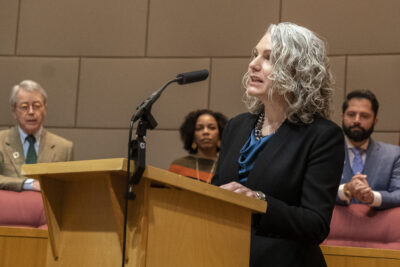
In 2020, as leader of United Way of Central Carolinas, Laura Yates Clark was instrumental in launching the local COVID-19 Response Fund.
United Way led her to a new position with the Council for Children’s Rights, a child advocacy center in Charlotte, where she served as the director of research and planning and the director of the Larry King Center. There, her educational background really came in handy as she focused on research, community planning and public policy advocacy to improve community-level outcomes for children.
In 2013, Laura joined Renaissance West Community Initiative as its founding CEO. Renaissance West was an effort to revitalize the old Boulevard Homes housing project in West Charlotte using mixed-income housing and wraparound services for children and families, including a school and a facility for seniors. Following what she learned from her community psychology studies, Renaissance West was a project built to create a comprehensive, holistic approach to fighting poverty that challenged the systems in place and how a community accessed them.
“When I decided to take the job there were several community leaders that told me not to do it,” Laura told WFAE in 2023. “They said, ‘You’re going to ruin your career. It’s never going to happen.’ … I think Charlotte wants quick solutions and easy wins. And these issues are just much more complex than that.”
Laura rejoined United Way in 2016 as executive vice president and chief impact officer, leading efforts to improve economic mobility and advance racial equity across four counties. In 2018, she was named president and CEO. At the time, she was just the sixth leader of the organization since it was formed in 1931 – and probably the first to start at the United Way on a temporary basis.
4. LYC: Tap dancer, extraordinaire
As a kid, Laura studied dance for almost 15 years – mainly ballet but also other forms, such as tap. She last (reluctantly) put the tap shoes back on in 2015 for a Charlotte Business Journal’s 40 Under 40 talent display. On the way to the event, she remembers jokingly begging her then-husband to turn the car around. Still, Laura went through with it.
Fear of failure, embarrassment and anxiety keep people from both trying bold things and achieving bold results. But Laura, metaphorically, puts her head down and keeps tapping.
Laura rejoined United Way in 2018 – just in time for the COVID-19 pandemic, which reconfigured much of society and upended our region’s social safety net, impacting the least fortunate the most. The local branch of the national organization was founded in Mecklenburg County 90+ years ago as “emergency relief” for people affected by the Great Depression. In 2020, the United Way of Greater Charlotte faced a similar mandate.
To assist nonprofits that were aiding the folks who needed it the most, Laura and United Way teamed with Foundation for the Carolinas to launch the Charlotte-Mecklenburg COVID-19 Response Fund. Along with former Foundation CEO Michael Marsicano, Laura helped lead fundraising efforts that distributed more than $23.5 million through 412 grants to 240-area nonprofits, with another $1.6 million raised to assist nonprofits in the region. More than 1,200 donors contributed to the fund, making it the ultimate community effort.

Laura’s loves include animals and volunteering. She recently led FFTC staff on a volunteer project to celebrate Earth Day at stables on the Anne Springs Close Greenway.
In a 2022 interview with CBJ highlighting the achievements of the fund, Laura was already looking ahead to the next challenge: “What that does is give me hope that Charlotte can solve anything,” she told reporter Erik Spanberg. “I think Charlotte is a town that, when we decide to make something happen, we make it happen. And I think about economic mobility and the growing disparities. I believe that we can tackle it, and we can see a different outcome — and the fund helped affirm that for me.”
Behind the scenes at the United Way, Laura was navigating funding challenges herself, as well as a desire to make a larger impact with the dollars available to distribute. The COVID-19 pandemic taught Laura and other community leaders the importance of having a healthy support system, listening to nonprofits doing the work on the ground and coordinating agencies for a larger impact.
This knowledge led Laura to change the United Way of Greater Charlotte’s funding methods to invest in grassroots and neighborhood-based organizations rather than larger, more-established nonprofits. The COVID-19 pandemic helped shine a light on smaller groups doing great work, but Laura and her team had to build stronger relationships with nonprofits they had not previously worked with.
“We had not shown up in their communities historically, and so we had to really work to build the trust of those groups and make sure we were building something together that was going to get the impact we wanted,” Laura said.
After successfully launching and leading its funding methods initiative, Laura felt leaving United Way in 2024 to join FFTC was the right move. As president of the organization, she led the Foundation’s civic initiatives, focusing her first two years on supporting nonprofits still recovering from the pandemic and other funding challenges.
“The folks that are running nonprofits are the ones on the front lines every day,” Laura said. “They are housing and feeding people, running important education programs, making sure children are ready for school and running health programs.”
In spring 2026, Laura succeeded CEO Cathy Bessant to lead the organization.
5. Food, board service and animals are her hobbies
Perhaps not surprising, Laura spends a good portion of her free time … volunteering her free time. Even in college, she found herself volunteering at that domestic violence shelter as a way to make an impact.
She currently serves on the Purpose Built Communities Board of Directors and the UNC Charlotte Board of Visitors. Previously she served as a board member of NC Child and United Way of North Carolina. She has also held leadership roles as chair of the board of the Federal Reserve Bank of Richmond, Charlotte Branch.
“I try to find things that are going to have the biggest impact,” Laura said about her board work. “Take the Purpose Built Communities board I’m currently on – that’s a nationwide model of trying to do neighborhood revitalization to improve outcomes for children and families. That model has the opportunity to lead to systemic change. That’s what’s interesting to me about it.”
When not working or volunteering, Laura is a big animal lover who loves reading, cooking and just being home.
“I’m half-Italian, so I lean towards, especially if I’m having people over, doing a lasagna, stuffed shells, meatballs – that kind of thing,” Laura said. She still has the antique farmhouse table that served as her family’s dining room table growing up.
Her love of food, books and dogs is probably why Laura told CBJ in 2015 her dream is to own a bookstore/café/dog bar.
For now, that dream will have to wait, as Laura takes on the leadership of the Foundation.
“I’ve seen so much change, and we’ve had so much growth in Charlotte throughout my life,” Laura said. “If we want to be in a world-class city, we have to face the challenges that come with that growth head-on, and I’m very motivated to keep coming to the table to try to improve things for everybody in Charlotte.”